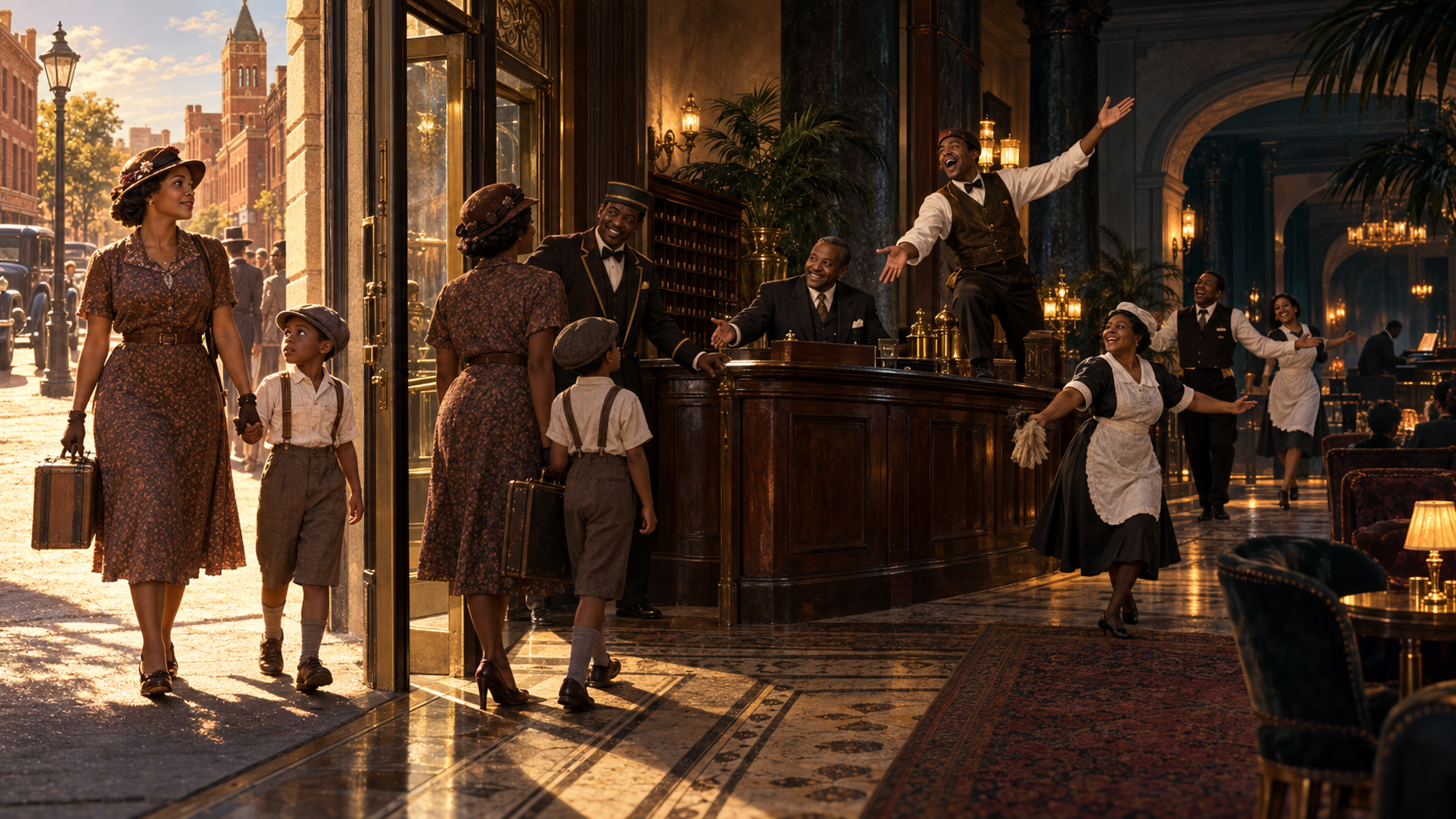
1935 · Five Points, Denver
The
Rossonian
“When you get those Jim Crow blues,
it’s the Rossonian you should choose.”
The dramatic entrance
From the heat
into the music.
Dottie and her eight-year-old son step out of the hard Denver sun and into a darkened lobby. For a woman whose life has been measured in ranches, farms and the enormous skies of the Great Plains, the Rossonian is another world.
The desk clerk looks up. A porter sees them hesitate. A cleaner stops mid-sweep. Then the room takes over the story.
The real Rossonian
A room.
A welcome.
Dignity.
The Rossonian Hotel stood at the heart of Denver’s Five Points neighborhood. Built in 1912 as the Baxter Hotel in the Beaux-Arts style, it became known as the Rossonian in 1929 and emerged as a major jazz destination in the American West.
For Black travelers and performers in an era of widespread racial discrimination, the Rossonian offered what many of Denver’s finest hotels would not: a room, a welcome and dignity.
The musicians associated with its world include Duke Ellington, Count Basie, Nat King Cole, Ella Fitzgerald, Billie Holiday, Louis Armstrong, George Shearing and Dinah Washington.
The contradiction was stark. Black musicians could perform for white audiences in prestigious downtown establishments, then be denied lodging when the performance was over. So they came to Five Points. They came to the Rossonian.
Inside Achtung, Cowboy
Denver was supposed to be only a stop along the way.
After the Dust Bowl of 1935 destroys their livelihood in Nicodemus, Kansas, and threatens young John’s life with dust pneumonia, the Carter family sets out for Oregon. With almost nothing left, James, Dottie and John find temporary shelter at Zion Baptist Church in Five Points.
Through the generosity of the church and Denver’s Black business community, James learns of work in the Colorado mountains of Grand County. Before the family leaves, Dottie and John wander the neighborhood—and see the Rossonian.
Beyond its doors lies an America that has spent generations telling people like the Carters where they may live, eat and sleep. Inside, another America is playing.
The song
History,
with the volume
turned up.
The Rossonian does not attempt to recreate the sound of 1935.
Instead, it takes the swagger, sophistication and energy of Denver’s Five Points and pushes it through the musical language of Achtung, Cowboy: blues, jazz, funk and hard rock colliding in a modern theatrical arrangement.
The song begins almost as a sales pitch. The clerks and porters see Dottie and her young son standing uncertainly inside the hotel, and decide to tell them exactly where they have wandered.
What follows is part welcome, part advertisement, part history lesson and part indictment. The Rossonian boasts of its elegance, hospitality and music while naming the Denver hotels that would profit from Black entertainers but refuse to offer those same performers a room for the night.
“When you get those Jim Crow blues,
it’s the Rossonian you should choose.”
A note for the stage
The music is deliberately bigger and more contemporary than the period in which the scene takes place.
to another generation.The music
does not.
Listen again